A few of my brothers and sisters in mission have decided as part of Lent to write and share devotionals with one another. I thought I would share mine with the rest of the world too. I shared this exercise on a retreat with my Wesley Foundation Campus Ministry at Michigan a few years ago, and I though it would be worth sharing again, as I've thought about it recently.
Take out a piece of paper. Go on, I promise you won't have to share your feelings with anyone if you don't want to. Fold the paper in half, whichever way is natural for you. Take about 3 minutes and make a list or word cloud on one half of the paper to answer this question: in what ways do you communicate with God?
Don't read on until you've done this!
Got it? Good!
Now take another 3 minutes to write on the other half of the paper the answer to this question: in what ways does God communicate with you?
Finished? Go ahead and read on.
What do you notice about the two halves? After reading and responding to the two questions, how do you perceive them to be distinct?
I'll share two of my thoughts. I have the privilege of knowing both questions a priori, but my first list of ways I communicate with God looks kind of bland. It mostly says "prayer" and I've listed different modes. I also listed worship in song and instrument, and also writing. My list second list of ways God communicates with me is much richer. Nature, friends, urges, discomfort, brokenness, scripture, food, and many more. 1 Thessalonians 5 commends us to pray without ceasing, and I might expand that to say: be in communication with God at all times. Take in those moments of natural beauty and thank God. Sit in the brokenness and search for direction. Cherish that Godly advice from a trusted friend, and know that all of these are gifts from the Giver.
Secondly, I find my prayer life can be focused more on the "how do I communicate with God" part and less on the "how does God communicate with me" part. True communication is a two-way street. How is it with your soul? Given the ways that God communicates with you, what can you do today to change your lifestyle, habits, or environment to listen to the voice of God more clearly? I have to ask myself these questions as well.
One of my favorite Psalms is Psalm 19:1-4a (NRSV). To wrap up, read the words slowly, and let them flow in and around you as you read.
The heavens are telling the glory of God;
and the firmament proclaims his handiwork.
Day to day pours forth speech,
and night to night declares knowledge.
There is no speech, nor are there words;
their voice is not heard;
yet their voice goes out through all the earth,
and their words to the end of the world.
Go into your day knowing we follow a God who calls us by name, if only we would listen.
Wednesday, March 19, 2014

Wednesday, March 12, 2014
sabbath post: sunset over capitol hill east
Spring is one of my favorite times of year. After a long, cold winter, 50 degrees feels like t-shirt weather. On top of that, I find that when the seasons change, that's when the best sunsets happen!
Below is a view from my doorstep in the Capitol Hill East neighborhood from last Friday. The yellows, pinks, and purples echoed down A Street as I walked up to the front door, and I couldn't resist pulling out my camera.
I was exhausted by the end of the day. I bolted out of work just after 5:00pm, knowing that a crazy two weeks of seminars would be just around the corner. As I headed out from the United Methodist Building, I noticed the sun setting in spectacular color over the Capitol Dome as the Washington Monument peeked up over the horizon a little behind. I thought to myself, it would be awesome to climb the steps of the Supreme Court and check out the view. I decided to buzz home instead, and probably missed a great opportunity to observe the beauty of creation and catch a glimpse of God.

It's a crazy season at the UM Seminar Program. We'll have eight seminars over the next two weeks. It sometimes feels like survival mode, just doing everything necessary to make sure the seminars flow well, and if they don't, taking corrective action.
I decided over Lent to focus on making sure I get enough rest. Mostly I am hoping to get eight hours of sleep per night. Sometimes, it's just not practical, but I try as a spiritual discipline to make it happen. I think that rest also extends to taking a few minutes to appreciate God's creation.
After work on Monday, the first day of "March Madness" at the Seminar Program, it was 60 degrees and sunny, plus we had an extra hour of daylight thanks to Daylight Savings Time. I made some dinner and ate outside, enjoying the fresh air, sunshine, some music in my headphones, and food. It was a great recharge, even for a moderate extrovert like myself. I'm looking forward to appreciating the beauty of life and creation more often.
Take time to be holy; the world rushes on.
Below is a view from my doorstep in the Capitol Hill East neighborhood from last Friday. The yellows, pinks, and purples echoed down A Street as I walked up to the front door, and I couldn't resist pulling out my camera.
I was exhausted by the end of the day. I bolted out of work just after 5:00pm, knowing that a crazy two weeks of seminars would be just around the corner. As I headed out from the United Methodist Building, I noticed the sun setting in spectacular color over the Capitol Dome as the Washington Monument peeked up over the horizon a little behind. I thought to myself, it would be awesome to climb the steps of the Supreme Court and check out the view. I decided to buzz home instead, and probably missed a great opportunity to observe the beauty of creation and catch a glimpse of God.
It's a crazy season at the UM Seminar Program. We'll have eight seminars over the next two weeks. It sometimes feels like survival mode, just doing everything necessary to make sure the seminars flow well, and if they don't, taking corrective action.
I decided over Lent to focus on making sure I get enough rest. Mostly I am hoping to get eight hours of sleep per night. Sometimes, it's just not practical, but I try as a spiritual discipline to make it happen. I think that rest also extends to taking a few minutes to appreciate God's creation.
After work on Monday, the first day of "March Madness" at the Seminar Program, it was 60 degrees and sunny, plus we had an extra hour of daylight thanks to Daylight Savings Time. I made some dinner and ate outside, enjoying the fresh air, sunshine, some music in my headphones, and food. It was a great recharge, even for a moderate extrovert like myself. I'm looking forward to appreciating the beauty of life and creation more often.
Take time to be holy; the world rushes on.
Thursday, March 6, 2014
diversity stories
This week began what my supervisor and I have dubbed “March Madness” where we have quite the flux of spring breakers knocking at the door of the Methodist Building. We use this term in the most loving way possible – I absolutely love having the excitement of people and energy in and out of the Building, eager and ready to change the world. It sure does keep us on our toes though. The latest winter storm "buried" DC under about 3 inches of snow, closing the Federal Government and most of the city on Monday, and making it difficult for our presenters and resource people to join us. But whether sleet, or hail, or stormy gale, the Seminar Program goes on!
This week was a treat for me. My crew (or at least twelve of them) from the Wesley Foundation at the University of Michigan (which, incidentally, is the oldest campus ministry in the Americas no matter what UIUC Wesley says) has been here for a seminar. I have very much enjoyed catching up on stories and hugs, and also learning right along-side my group!

The topic was race relations and affirmative action. This topic came up for the group because in Michigan, voters passed a referendum which said it is illegal to use race as a criteria for college admission, among other things. Since then, there has been a decline in enrollment notably among African American students and other racial minorities at University of Michigan. This has created a lot of racial tension on campus.
In addition to informational and interactive seminar sessions, we also had the chance to listen to historian Harold Bell at Ben’s Chili Bowl and share in Ash Wednesday service with the Wesley Foundation at Howard University. All of these experiences gave us ample opportunity to dialog about race and affirmative action.
I think I could write quite a bit about this topic, but I just want to lift up a reflection from my own experience. One distinct memory I have from college was trying to get my first internship. I talked to recruiter after recruiter at career fair, just hoping to get an interview. I didn’t expect that I would have to beg my way into an interview with my nearly 4.0 GPA, but that’s what I did. I really wanted to get in with one of the Big Three auto makers, but I ended up with an internship with a relatively small engineering firm that most people (including myself) had never heard of. Thankfully, I ended up with something, and it turned out to be a great experience! After career fair, I talked with one of my female engineering friends about how things went. She had her choice of offers from Ford, GM, and many others. I was pretty steamed about this, thinking she probably got her pick of awesome internships because of affirmative action.
I think that frustration is real for people, and I don’t think it is wrong. In fact, I think it’s good to acknowledge it, name it, and talk about it. I’ve learned that you can’t really help how you feel, only how you react. It is good to reflect (whether alone, with others, or in prayer) on feelings and understand them. Well, at least for a thinker like myself, this is helpful. Feelings don’t do much for me unless I can understand why I feel a certain way.
As I think back on this, I can make a couple conclusions. First, I can’t say for certain if affirmative action is why she had so many offers. She could have been more involved on campus than me (very likely), less socially awkward than me (very likely), and better at selling herself than me (very likely). Second, diversity is valuable, and I have a better understanding of that now. Long story short, increased diversity allows us collectively to problem solve from increasingly diverse angles and perspectives. Why is this important? Attacking problems from one direction may work, but there may be better approaches which are not obvious to people of one particular culture. If I’m running around the world moving everyone’s dining table into their bedrooms, I could miss out on a better solution. I could also miss the opportunity to collaborate to find an even better solution than either group could reach in isolation.
I thought Rev. Mulenga, who spoke to my group today and is the father of one member of the group, had a great spiritual insight. Humans are an image or reflection of the Invisible God. One human or one people group cannot capture that image fully, so God gave us diversity to help express that better. One is not more valuable than another, but all help to reflect God’s glory in different ways.
How are we reflecting that glory? Let me leave you with this “living-in-the-tension” kind of question as I also ponder it.
This week was a treat for me. My crew (or at least twelve of them) from the Wesley Foundation at the University of Michigan (which, incidentally, is the oldest campus ministry in the Americas no matter what UIUC Wesley says) has been here for a seminar. I have very much enjoyed catching up on stories and hugs, and also learning right along-side my group!
The topic was race relations and affirmative action. This topic came up for the group because in Michigan, voters passed a referendum which said it is illegal to use race as a criteria for college admission, among other things. Since then, there has been a decline in enrollment notably among African American students and other racial minorities at University of Michigan. This has created a lot of racial tension on campus.
In addition to informational and interactive seminar sessions, we also had the chance to listen to historian Harold Bell at Ben’s Chili Bowl and share in Ash Wednesday service with the Wesley Foundation at Howard University. All of these experiences gave us ample opportunity to dialog about race and affirmative action.
I think I could write quite a bit about this topic, but I just want to lift up a reflection from my own experience. One distinct memory I have from college was trying to get my first internship. I talked to recruiter after recruiter at career fair, just hoping to get an interview. I didn’t expect that I would have to beg my way into an interview with my nearly 4.0 GPA, but that’s what I did. I really wanted to get in with one of the Big Three auto makers, but I ended up with an internship with a relatively small engineering firm that most people (including myself) had never heard of. Thankfully, I ended up with something, and it turned out to be a great experience! After career fair, I talked with one of my female engineering friends about how things went. She had her choice of offers from Ford, GM, and many others. I was pretty steamed about this, thinking she probably got her pick of awesome internships because of affirmative action.
I think that frustration is real for people, and I don’t think it is wrong. In fact, I think it’s good to acknowledge it, name it, and talk about it. I’ve learned that you can’t really help how you feel, only how you react. It is good to reflect (whether alone, with others, or in prayer) on feelings and understand them. Well, at least for a thinker like myself, this is helpful. Feelings don’t do much for me unless I can understand why I feel a certain way.
As I think back on this, I can make a couple conclusions. First, I can’t say for certain if affirmative action is why she had so many offers. She could have been more involved on campus than me (very likely), less socially awkward than me (very likely), and better at selling herself than me (very likely). Second, diversity is valuable, and I have a better understanding of that now. Long story short, increased diversity allows us collectively to problem solve from increasingly diverse angles and perspectives. Why is this important? Attacking problems from one direction may work, but there may be better approaches which are not obvious to people of one particular culture. If I’m running around the world moving everyone’s dining table into their bedrooms, I could miss out on a better solution. I could also miss the opportunity to collaborate to find an even better solution than either group could reach in isolation.
I thought Rev. Mulenga, who spoke to my group today and is the father of one member of the group, had a great spiritual insight. Humans are an image or reflection of the Invisible God. One human or one people group cannot capture that image fully, so God gave us diversity to help express that better. One is not more valuable than another, but all help to reflect God’s glory in different ways.
How are we reflecting that glory? Let me leave you with this “living-in-the-tension” kind of question as I also ponder it.
Wednesday, February 26, 2014
missions 101
Right now, I’m in Richmond, VA spending some time with the next group of young adult missionary candidates through the Generation Transformation program. These are Interview and Discernment Days, which means the candidates get some time to hang out and discern with us, and also the opportunity to have a more formal interview to see if the program is a good fit.
Tonight, one of our staff, Patti, shared a silly story which gets to a great point about missions. Imagine I come to your place for a visit, and I’m the type of person who is eager to help people do things better. I notice that your dining table is in your kitchen. I say, “Goodness, why do you eat in here? I keep my dining table in my bedroom and it’s WAY better in there. You ought to change. Look, I’ll even help you move it. Then you’ll learn how great it is, and you can teach your friends also!”
A very simple story, and I know it is easy to pick out bugs, but let’s take a closer look. I want to highlight three things about it from a missions perspective.
First, it’s awesome to be willing and eager to help people. The enthusiasm and energy of people on missions trips is wonderful! I’ve been there myself. Here is one dilemma that is easy to get caught in. No needs assessment was performed in the case of me coming to your house. I didn’t find out if you even have any problems that you want to work together to solve! In fact, I didn’t even say that you and I have any kind of relationship to begin with, so your culture and way of life might be totally lost on me! Mission ought to start with forming relationships, understanding community assets, and also clarifying community concerns.
Secondly, a good question to note is this: whose way is actually better? Where does it make sense to put the dining table? This could be asked from a utilitarian standpoint, and also should be asked from a cultural or traditional standpoint. Probably most people would say that it makes sense for the table to be in the kitchen. On the other hand, maybe in my home (culture), we have little kitchens and big bedrooms, so it actually makes more sense for my table to be in my bedroom. This might not be true in your home though.
Finally, in the story, I’m not coming in with an attitude of learning. Instead of telling you that your table is in the wrong place, I could find out why you put your dining table in the kitchen. Perhaps I would learn that this indeed is a better way of doing things! I could return home, move my table into the kitchen, and show my friends this great trick I learned from another person I met. To me, this is one of the core values of mission – learning something new about a people and bringing the story home to share.
The excitement and enthusiasm to serve is great among people these days. Lots of people want to give of their time and money to join a culture of service. While serving, it’s so important to remember how much we can learn from others, even those we perceive as needy or lacking. It’s also important to realize that blindly serving without considering the true assets and needs of a community could lead to more problems, not just a silly story.
We’re all created in God’s image with great value, and we all have experiences to share. Mission is all about sharing those stories and joining forces to resolve those things we call problems. That includes the problems in the lives of those who seek to serve. We’re all broken people, and we’re all in this thing together.
Wednesday, February 19, 2014
sabbath post: the wind-blown Spirit
So here I am, bedtime on a Wednesday night, just sitting down to my blog. I actually have a pile of ideas I'd like to expand on, but I'm trying to renew my commitment to getting appropriate rest. I just didn't have time for a thorough blog post this week, so I'm starting a new tradition of Sabbath posts so I can keep my commitment of Wednesday posts and also make sure I get enough sleep.
One of my favorite scriptures is John 3:8.
The wind blows where it chooses, and you hear the sound of it, but you do not know where it comes from or where it goes. So it is with everyone who is born of the Spirit.
I like things to be linear, structured, and organized. This verse is not comforting to me. How can I figure out life when it just blows all over the place? And Jesus is telling me that's how it goes with people born of the Spirit?
I first started to actually enjoy this scripture when I started seriously considering God's calling on my life. It's not straightforward, there is no system or ten-step process to follow. We get the Spirit to follow, and the Spirit blows like the wind!
How does this verse inform your calling? Also, how are you getting some Sabbath rest lately?
Thursday, February 13, 2014
what can a toy tell me about masculinity?
One of my first experiences of the new year was attending a Healthy Masculinity Training Institute by an organization called Men Can Stop Rape. To quote their mission statement, they want “To mobilize men to use their strength for creating cultures free from violence, especially men's violence against women.” Part of that training consisted of thinking more deeply about masculinity and what it means to be a man.
Toward the beginning, we had a discussion around two “word clouds,” which are below. They were formed by recording the words in toy commercials, tallying the number of times certain words were said, and adjusting the size of the word based on the tally. So, the larger the word, the more times, relatively, it showed up in commercials. You can read more about it here if you like.
Take a minute and look at each one before reading on. What do you observe?
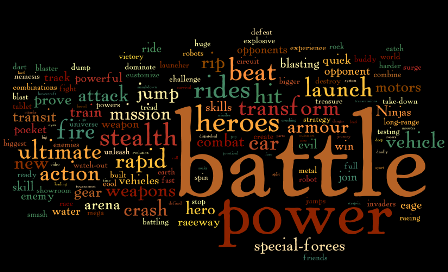

I’ve had a few good conversations and email exchanges over these two very interesting images. As a man, the violence of the boy’s word cloud is what immediately caught my eye. Boys learn all about battle, power, weapons, and similar things from a young age. While I get a certain sense of nostalgia upon reading these words, thinking back on Ninja Turtles, Nerf guns, and the like, I have to also think more about the violence I was exposed to when I was young, and how much it guided or informed my view of the world. These words could be harmful if a boy finds his identity or worth in them.
On the other hand, typical girls’ toys are described by "softer" words. To me, a lot of these divide up into two categories. One category is of words focused on appearance – pretty, hair, nails, style, etc. These may be harmful if a girl finds her identity and worth in them. The second category is of words which I would call valuable, like love, fun, and friendship. To me, these are some of the things that life is all about. When mixed in with the first group of words, though, they could become problematic, implying that things like love and friendship are on par with, or worse, come from things like pretty and style. In this sense, I can see how some people would come to the conclusion that all of these words promote a softness, weakness, or passivity.
Additionally, it's interesting to note that that words like these are pretty much absent from the boys’ word cloud. To be fair, I do see words like buddy, friends, and skill, but they are overwhelmed by other words.
Just a quick caveat before we continue: I’m not saying toy advertising defines masculinity or femininity, nor does it completely determine how kids turn out, but to me, the images reflect a certain truth about the cultural environment we all grow up in as Americans.
To see marketing presented this way is a bit startling. Do we value violence as a people? Do we value weakness or passivity? I don’t think anyone would say they truly value these things.
I think they are marketed this way because of a certain status quo. “Boys like battles because they have always liked battles; girls like tea parties because they have always liked tea parties. Why change?” Changing takes energy, introspection, and conversation, and if people can't see a good reason to invest the time and energy, they won't do it. I don't think there is some conspiracy of men who consciously decides training boys to be violent and girls to be passive is a good idea. I think it’s more of a neglect to see that we could do things a different and better way.
I’m also not coming from the place where I think all aspects of gender should be up-ended. Just the harmful parts. Changing a few things could yield profound results, like men who use their strengths and gifts for creation and healing rather than violence and destruction, and, likewise, women who realize and use their strengths and gifts to make the world a better place.
In short, my hope is that we create environments where we can discover and live into the call of God rather than the call of society.
Toward the beginning, we had a discussion around two “word clouds,” which are below. They were formed by recording the words in toy commercials, tallying the number of times certain words were said, and adjusting the size of the word based on the tally. So, the larger the word, the more times, relatively, it showed up in commercials. You can read more about it here if you like.
Take a minute and look at each one before reading on. What do you observe?
I’ve had a few good conversations and email exchanges over these two very interesting images. As a man, the violence of the boy’s word cloud is what immediately caught my eye. Boys learn all about battle, power, weapons, and similar things from a young age. While I get a certain sense of nostalgia upon reading these words, thinking back on Ninja Turtles, Nerf guns, and the like, I have to also think more about the violence I was exposed to when I was young, and how much it guided or informed my view of the world. These words could be harmful if a boy finds his identity or worth in them.
On the other hand, typical girls’ toys are described by "softer" words. To me, a lot of these divide up into two categories. One category is of words focused on appearance – pretty, hair, nails, style, etc. These may be harmful if a girl finds her identity and worth in them. The second category is of words which I would call valuable, like love, fun, and friendship. To me, these are some of the things that life is all about. When mixed in with the first group of words, though, they could become problematic, implying that things like love and friendship are on par with, or worse, come from things like pretty and style. In this sense, I can see how some people would come to the conclusion that all of these words promote a softness, weakness, or passivity.
Additionally, it's interesting to note that that words like these are pretty much absent from the boys’ word cloud. To be fair, I do see words like buddy, friends, and skill, but they are overwhelmed by other words.
Just a quick caveat before we continue: I’m not saying toy advertising defines masculinity or femininity, nor does it completely determine how kids turn out, but to me, the images reflect a certain truth about the cultural environment we all grow up in as Americans.
To see marketing presented this way is a bit startling. Do we value violence as a people? Do we value weakness or passivity? I don’t think anyone would say they truly value these things.
I think they are marketed this way because of a certain status quo. “Boys like battles because they have always liked battles; girls like tea parties because they have always liked tea parties. Why change?” Changing takes energy, introspection, and conversation, and if people can't see a good reason to invest the time and energy, they won't do it. I don't think there is some conspiracy of men who consciously decides training boys to be violent and girls to be passive is a good idea. I think it’s more of a neglect to see that we could do things a different and better way.
I’m also not coming from the place where I think all aspects of gender should be up-ended. Just the harmful parts. Changing a few things could yield profound results, like men who use their strengths and gifts for creation and healing rather than violence and destruction, and, likewise, women who realize and use their strengths and gifts to make the world a better place.
In short, my hope is that we create environments where we can discover and live into the call of God rather than the call of society.
Subscribe to:
Posts (Atom)